Kilimanjaro Hiking Rongai Route 7 Days

7 Days
  • 12
  • 65
  • 1
  • 4 Stars Hotels
  • Bus, Airlines
  • 5,416 metres
  • Kathmandu
  • Feb, Mar, Apr & May
  • Available
  • All meals during the trip
  • English, Spanish, French, Chinese
  • 5-8 Hours
  • Available

Overview

The Rongai route is the only route that approaches Kilimanjaro from the north, close to the Kenyan border. Though gaining popularity amongst climbers, Rongai has low traffic. It is the preferred route for those looking for an alternative to the crowded Marangu route, for those who would like a more remote hike, and for those who are climbing during the rainy season (the north side receives less precipitation).
The minimum number of days required for this route is six days, and seven days are recommended. Although the scenery is not as varied as the western routes, Rongai makes up for this by passing through true wilderness areas for days before joining the Marangu route at Kibo camp. This route descends down the Marangu route. Rongai is a moderately difficult route and is highly recommended, especially for those with less backpacking experience.

Highlights

  • The only route approaching Kilimanjaro from the north, offering a peaceful and less crowded trek.
  • Ideal for climbing during the rainy season, as the northern side receives less precipitation.
  • Trek through untouched, wild landscapes before joining the Marangu route at Kibo Camp.
  • A great choice for climbers with less experience, offering a challenging yet achievable climb.
  • Typically completed in six days, with seven days recommended for better acclimatization.
  • Pass through diverse ecosystems, from lush rainforests to alpine deserts.
  • End your journey by joining the Marangu route and descending down for a complete Kilimanjaro experience.

Itinerary

  • Day
    01

    Arrival in Tanzania – Kilimanjaro International Airport

    Upon your arrival at Kilimanjaro International Airport, our representative will be waiting to welcome you. You will then be transferred to Maridadi Hotel, where you can relax and recover from your flight.

    If you are already in Tanzania, we can also arrange pickup around Moshi/Arusha and transfer you to Maridadi Hotel, where the tour will begin.

    In the evening, you will meet your mountain guide for a detailed briefing. He will go over the itinerary, provide important tips, and advise you on what to wear and pack to ensure a safe and comfortable climb.

    Breakfast + Lunch + Dinner
    Hotel
  • Day
    2

    Hotel - Nalemoru Gate (1990m) to Simba Camp (2625m)

    This morning we will drive from Hotel Arusha/Moshi to the village of Nale Moru for the starting point of the Rongai route. The first stage of the trek is through farmland and pine forests. You may have a chance to see the beautiful Colobus monkeys or if you’re lucky enough, elephants or buffalos en route. Our first camp will be the Simba Camp located at the edge of the moorland zone at 2625m.

    Distance covered: 8km / 5mi
    Approx. time taken: 4 – 5 hours

    Breakfast + Lunch + Dinner
    Mountain Camping Tent Stay
  • Day
    3

    Simba Camp (2625m) to 2nd Cave Camp (3480m)

    Today’s trek begins with a steady ascent up to the ‘Second Cave’ (3450m) with superb views of Kibo and the Eastern ice fields on the crater rim.
    Our path is lined by a variety of flowers including Carduus keniensis and bright red gladiolus. After stopping for lunch, we leave the main trail and set out across the moorland on a smaller path towards the jagged peaks of Mawenzi.
    As we trek we sight Lobelia deckenii, unique to the Kilimanjaro moorland zone. Our campsite is in a sheltered valley encircled (collocated) with giant senecios (Dendrosencio Kilimanjaro) near Kikelewa CavesHiking 

    Distance covered: 5km / 3.1mi
    Approx. time taken: 3 – 4 hours

    Breakfast + Lunch + Dinner
  • Day
    4

    2nd Cave Camp (3480m) to Kikelewa Camp (3630m)

    Leaving the pine forest behind us carry on with a steady ascent walking through the moorland. There are superb views of the Eastern ice fields on the crater rim of Kibo, the highest of the three volcanoes that form the mountain. We will leave the main trail and strike out across moorland on a smaller path towards the jagged peaks of Mawenzi, the second of Kilimanjaro’s volcanoes. We will set up camp today in the sheltered valley near Kikelewa caves at 3630m
    Distance covered: 5km / 3.1mi
    Approx. time taken: 3 – 4 hrs

    Breakfast + Lunch + Dinner
    Mountain Camping Tent Stay
  • Day
    5

    Kikelewa Camp (3630m) to Mawenzi Tarn Hut (4310m)

    This morning we have a short but steep ascent up grassy slopes which is rewarded by a superb view of the Kenyan plains to the north. We leave vegetation behind shortly before reaching our next camp at Mawenzi Tarn Hut directly below the towering cliffs of Mawenzi. This afternoon you have a chance to rest or explore the surrounding area to aid acclimatization.
    Distance covered: 8km / 5mi
    Approx. time taken: 4 – 5 hours

    Breakfast + Lunch + Dinner
    Mountain Camping Tent Stay
  • Day
    6

    Mawenzi Tarn Hut (4310m) to Kibo Hut (4700m)

    We leave our campsite and cross the lunar desert of the ‘saddle’ between Mawenzi and Kibo After a couple of hours of trekking, reach this spectacular place, with the summit of Kilimanjaro in the background and our trail to the high camp stretched out before our eyes. Upon reaching our camp the remainder of the day will be spent resting in preparation of the final ascent after a very early night!
    Distance covered: 8km / 5mi
    Approx. time taken: 5 – 6 hours

    Breakfast + Lunch + Dinner
    Mountain Camping Tent Stay
  • Day
    7

    Kibo Hut (4700m) to UHURU PEAK (5895m) & down to Horombo Hut (3700m)

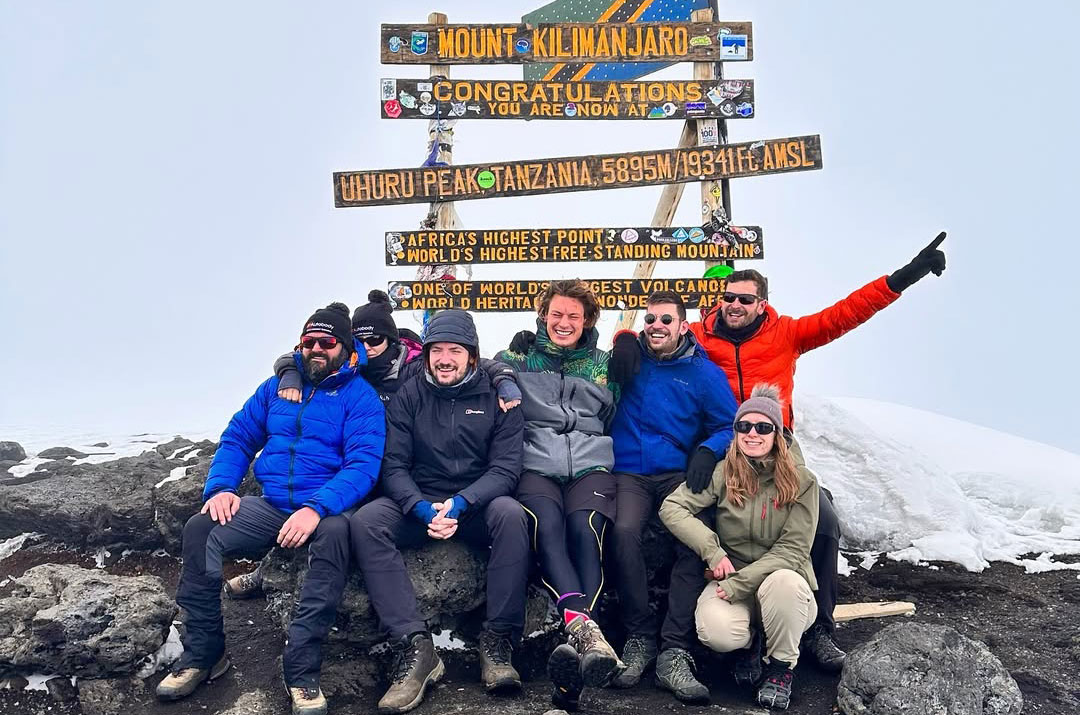
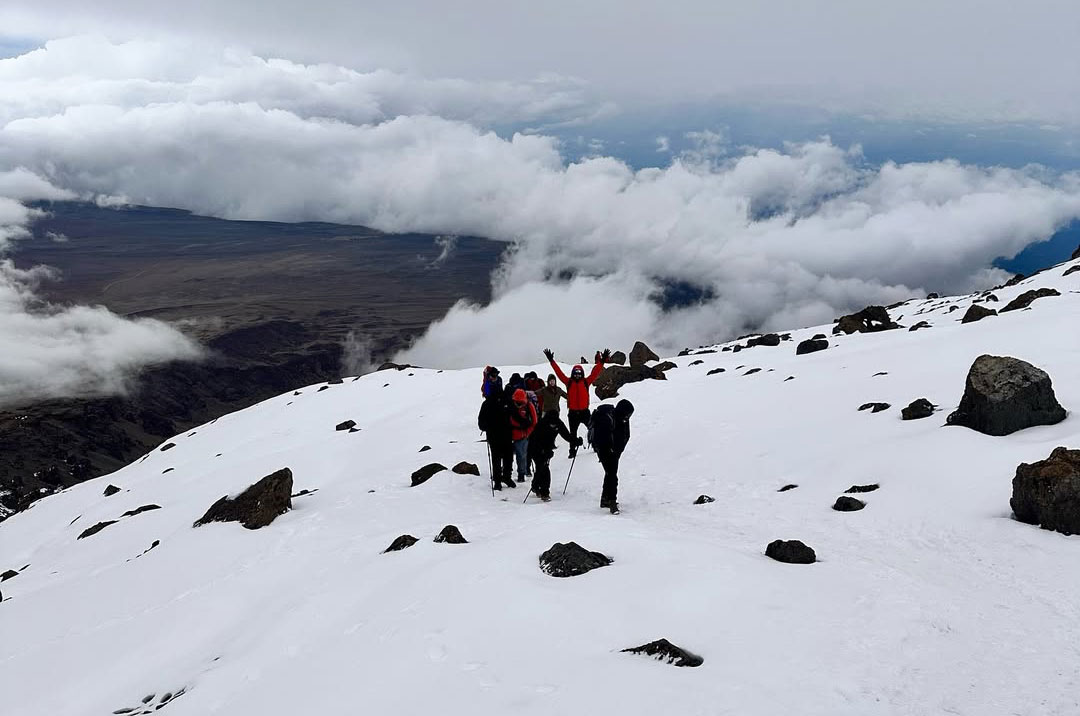
    Today is “The Big Day” – the summit stage. You will begin your final ascent around midnight which will be long and strenuous. Passing the Hans Meyer Cave at 5220m, the climb slowly but surely goes upwards. At sunrise, you will reach Gillman’s Point (5681m) – the crater rim of Kilimanjaro – where the sun will slowly start to warm up the land. You will have soon forgotten the cold of the night and after a further hike of 1 – 2 hours, you will reach Uhuru Peak at 5895m. On your return to Kibo Hut, a warm meal awaits you followed by a 1 – 2 hour break before proceeding back down to Horombo Hut.
    Distance covered: 22km / 13.7mi
    Approx. time taken: 12 – 15 hours

    Breakfast + Lunch + Dinner
    Hotel
  • Day
    8

    Horombo Hut (3700m) to Marangu Gate (1860m)

    The last stage passes through the heath and moor zone to the Mandara Hut (2700m) where a warm lunch is waiting for you. Soon, you will once again pass the tropical rainforest and after a total time of 6 hours trekking, you will be back at the Kilimanjaro National Park Gate (1860m). After saying goodbye to your mountain guides, a short transfer follows to take you back to your hotel in Moshi. Once there, you can take a warm and relaxing shower and celebrate your success in reaching the summit of the Kilimanjaro.

    Distance covered: 20.8km / 12.9mi
    Approx. time taken: 8 hours

    Hotel
  • Day
    09

    Departure

    Today marks the end of your unforgettable adventure. Enjoy your final moments in Tanzania before our driver transfers you to Kilimanjaro International Airport for your journey home.

    If you wish to extend your holiday, we can arrange an exciting safari in Tanzania’s national parks or a relaxing beach getaway in Zanzibar to complement your Kilimanjaro experience.


Number of Travelers in Group DiscountCost Per Traveler in US($)
1 Person2,500
2-4 People2,200
5- 7 People2,100
8 - People1,950

The Cost Includes

  • Pre & Post Trek accommodation
  • Professional guides, cooks and porters
  • Transportation to & from the mountain gate
  • Park fees, camping fees & rescue fees
  • VAT fees and Charges
  • Double layered Sleeping Mats
  • 3 meals daily while on the mountain
  • Filtered water throughout the trek
  • Portable toilets and toilets tents
  • Hot Water For Washing Purpose
  • Pick up and drop off at the airport.
  • Fair wages for the mountain crew.

The Cost Excludes

  • International flights
  • Tip to the driver guide and hoteliers
  • Insurance fees
  • Cost of Tanzania Visa.
  • Bank charges
  • Personal Expenses

FAQs

What is the Best Time of the Year for Climbing?

Mount Kilimanjaro can be climbed year-round, but the best times are during the dry seasons, from mid-June to October and December to February. These months offer clear skies and better weather conditions for the climb.

There are two rainy seasons: the long rains from March to May, and the short rains in November. While weather can vary, the dry months of July, August, September, and part of October, January, and February are considered the high season. The transition months—December, March, and June—are less predictable. The wettest months, with heavy rains and poor visibility, are April, May, and November.

For those seeking clear skies and good visibility, climbing during the dry season is ideal. However, some climbers prefer summiting during a full moon for a bright, beautiful ascent under the moonlight, adding to the experience with enhanced visibility and stunning landscapes.

How Qualified are the Guides?

Our guides are highly experienced, with years of climbing Kilimanjaro to earn their KINAPA National Park license. They are Wilderness First Responders, trained to handle injuries or emergencies.

They are proficient in using medical equipment, including oxygen, pressure altitude chambers, and stretchers. In case of an emergency, they can quickly facilitate communication with the Jaribu base using our Thuraya satellite phone.

Guides are also trained to assess when an evacuation is necessary and know how to carry it out safely.

What’s the Weather on Kilimanjaro?

Equatorial to arctic conditions are present on Mt Kilimanjaro and temperatures vary widely; it may be in the 20-32C range in the rain forest and -20C nearer the summit. Above the rain-forest and tree line, most days range between 0-20 C, however, the weather often changes dramatically without warning, so you must always be prepared for four seasons in one day including, rain, snow or a sudden hailstorm therefore making it very important to carry your waterproof shell at all times.

The most flexible way of adjusting to the ever-changing conditions as you trek higher is the layering of several thin articles of clothing which you can add or remove as the conditions dictate.

What Route Should I Climb?

Choosing the right route for climbing Mount Kilimanjaro depends on your preferences, experience, and goals. Here are some key factors to consider:

  • Marangu Route: Known as the "Coca-Cola" route, it's the only route with hut accommodation and is popular for its relatively easier ascent. It’s ideal for those with limited backpacking experience and for those seeking a shorter climb (5-6 days).

  • Machame Route: This is one of the most popular routes, offering stunning scenery and a slightly more challenging climb. It’s suitable for climbers looking for a more immersive experience with varied landscapes (6-7 days).

  • Rongai Route: For a more remote, less crowded experience, the Rongai route is ideal. It’s the only route approaching from the north and is great for avoiding heavy rainfall during the rainy season (6-7 days).

  • Lemosho Route: This route is known for its beautiful scenery and a longer duration (7-8 days), which provides better acclimatization. It's ideal for those looking for a less crowded experience with a slower ascent.

  • Northern Circuit: The longest and newest route, offering incredible views and a true wilderness experience. It’s perfect for those seeking a more gradual ascent and an off-the-beaten-path experience (9 days).

How long does it take to train to climb Kilimanjaro?

The time needed (days, weeks, or months) to train for Kilimanjaro depends upon your level of fitness. But usually, it requires around a month to be prepared for your trek. It is advisable to do staircase training, cardiovascular exercises and upper body exercises. Eat right and do more of aerobic exercises before the trip. Also if possible you can climb a hill to practice for the trek. Overall it is not necessary to be perfectly fit for climbing the mountain. As apart from physical training, mental preparedness is more important for high success rate on the summit.

Is it hard to climb Mount Kilimanjaro?

For experienced climbers, Mount Kilimanjaro will take around 5 to 6 days to reach the top, and is not that hard. Even for new climbers, our guides will help you climb the mountain with ease. But you need to give extra days for acclimatization for maximum success rate at the summit. For new climbers however, climbing Kilimanjaro becomes easier with our trained professionals and porters who help the climbers carry their essential equipment or gear up the summit.

What should I wear to Kilimanjaro summit?

We recommend you wearing multiple layers of clothing. It is the best way to keep your body in the desired temperature range no matter what the environment is. The temperatures you may encounter on Mount Kilimanjaro can be over 37 °C (degrees Celsius); 100 °F (degrees Fahrenheit) to well below zero.

How cold is Kilimanjaro summit?

At the Uhuru Point, temperatures can range between -7 °C to -29 °C (degrees Celsius); 20 °F to -20 °F (degrees Fahrenheit). Mount Kilimanjaro has extreme, variable, and impossible weather to predict. It is therefore advised to get many layers of clothing gear for the trek. Layering helps keep the body warm in extreme cold wave conditions on the summit. Migration Venture Africa provides these gears as a rental option as well.

What is the best month to climb Kilimanjaro?

The best time to climb Kilimanjaro are from January-March and June-October. Generally, January-March is colder than June-October and there is a higher probability of encountering snow on the summit. It depends on the climbers whether they want to experience the snow-covered peaks of the summit or the more pleasant time period after June. The beauty of the mountain is at its best during the dry season of June-October. It is advisable to climb the mountain during this time.

Where do you sleep on Kilimanjaro?

A comfortable sleep is very important to get reenergized at next morning to continue the trek. Kilimanjaro gear is necessary for a cozy sleep. Essential gear like a K-way sleeping bag, foam mattress, and Kilimanjaro pillow can be carried on the trek. Migration Venture Africa also provides these gears on rent for which it is necessary to apply beforehand. You can speak to our staff personally regarding any queries about the Kilimanjaro gears.